
Bleeding thunderbolts

There are nights when I think about two queens who never met and yet have been arguing inside me for years.
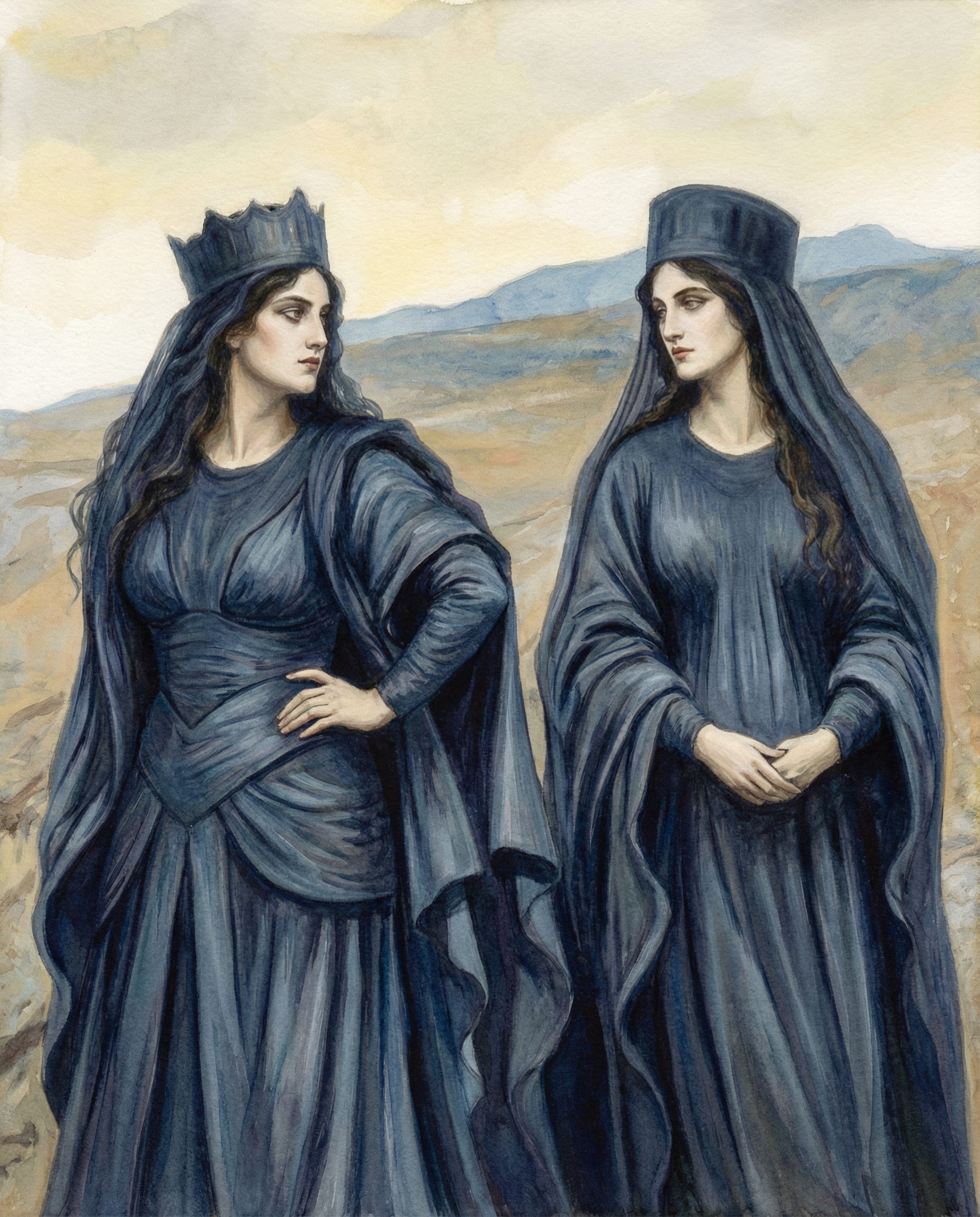
Not the papier-mâché queens of kindergarten Purim plays or the glittered tinsely crowns and hamantaschen. I mean the women themselves - Vashti and Esther, breathing somewhere beneath the text like embers under ash.
I’ve been reading Jewish mythology again. It feels like returning to a river I knew as a child, only to realise it was always deeper than I was told. As a teenager, I read The Red Tent and felt the floor open beneath me. Dinah’s voice; private, menstrual, furious, tender; was not second to the story of Jacob’s sons; she was the story. The women had always been there, threading lineage through blood and whisper and timing. As an adult, I return to these texts and feel less romantic, more alert. I see how often women appear only when the plot requires a womb or a temptation. And then there are these two naughty queens in Persia - Vashti and Esther- who refuse to behave.
The story unfolds in the Persian empire, in what we now call Iran. An empire of spectacle. Of banquets and edicts and men who believe power is something that must be displayed to be real. The king calls for Vashti to appear before his drunken court, to show her beauty as proof of his sovereignty. The instruction is kind of shrouded in celebration so that it doesn’t sound like force.
But she knows better. She does not come.
That is the first miracle of the story. A refusal.
I think about that often. About the dignity of not coming. Of not presenting your body or your voice to an audience that has already decided what you are for. Vashti loses her crown for it. She disappears from the text as swiftly as she entered. But the refusal stands there like a boundary stone.
And then orphaned beautiful Esther. Carried into the palace as part of a contest that reads more like a cattle auction. She doesn’t refuse bust instead learns the architecture of power from the inside. She waits. She times her words. When the decree to annihilate her people is signed, she risks death by approaching the king unsummoned. She lets the tension ripen until truth can’t be ignored and exposes Haman’s plot and saves her people.
If Vashti is the woman who says no, Esther is the woman who says not yet.
Two forms of courage and anatomies of survival.
And here we are again, with Persia humming in the background of history, with the women of Iran cutting their hair in the streets, with post October 7 Jewish women in the diaspora absorbing a different kind of stoning- that of the relentless ideological kind. I can’t read Purim anymore without hearing the present tense.
I find myself watching contemporary Jewish women who stand publicly in ways that cost them- women like Rachel Goldberg-Polin and Iranans like Elica Lebon- and I wonder which queen is guiding them on any given day. Are they refusing the humiliation of being miscast? Or are they navigating rooms that were not built for them, speaking a language that was designed to exclude them, bending it anyway?
And then, more uncomfortably, I ask: who am I in this lineage?
There is a temptation, especially now, to imagine oneself as Esther in every confrontation. To narrate one’s own bravery. To believe that speaking at all is the same as risking death. But it’s not that simple now.
I have also been thinking about the opposite of these women. About what it means not to be Vashti or Esther. To swim with the tide because the tide is piss warm. To glorify the popular like they themselves (often self appointed) are deities. To willfully misunderstand patterns because being clear would require actual sacrifice.
There’s a particular cruelty when women do this to other women. When the language of liberation is used as a weapon. When feminism becomes a weird broach with a watermelon on it. I think again of Grace Tame, not because she is “difficult” (LOL)- that word is too tiny -but more because she represents the morally violent opportunist. She represents the willingness to flatten a people into a symbol in order to secure one’s own standing within a chorus. I find that goddamn pathetic and weak.
History is full of women who aligned themselves with power because proximity felt like safety. Full of women who turned on other women for a cleaner narrative.
We speak often of patriarchal structures, and rightly so. But we don’t speak enough about the ways we participate in them when it suits us.
Vashti’s refusal was not popular. Esther’s strategy was not pure. Both would likely be cancelled by different corners of the internet. One for not playing the game and the other for playing it too well.
So where does that leave me?
Somewhere between the banquet hall and the threshold.
I am not a queen. I am a mother. An artist. A woman in Melbourne who has watched the world fracture in the last few years and felt the ground beneath her identity shift, against every expectation I had for my life and path. Since October 7, everything has changed. We’re living in a post dictionary world, in which the word Zionist is spat like a slur and empathy is rationed, depending on your ideological alignment.
I’ve felt the instinct to shrink so many times- maybe every day. To become the wallflower history has sometimes cast us as. To retreat into private rooms and sing old songs quietly, because there is real safety in invisibility.
But there is also rot.
Because beneath the surface, Jewish women have never been just decorative. We’ve been the a massive part of the infrastructure. The ones who taught children which way to run and who kept languages alive in kitchens and buried letters.
I think about my grandmothers. About the women who crossed oceans with recipes and grudges and hope stitched into hems. They did not call themselves pathmakers. They didn’t have Substacks. But they were architects of continuity.
And I think about the women in Iran now, whose names I may never know, who are risking imprisonment and worse for the right to breathe. The story of Purim is not a quaint folktale in that context. It is a warning and a mirror.
The script is old. What changes are the costumes. So what is my responsibility in this script?
This is the question that keeps me awake. At what point in history do we put our hands up and say: I am inside this story. I will not outsource my moral voice to louder people. I will not pretend neutrality is innocence.
Esther loved her people enough to risk her position. Vashti loved herself enough to refuse degradation. Both are forms of fidelity.
And courage is not a permanent state. It is a series of decisions made in unglamorous moments, often in the middle of the night, with sleeping baby saliva in your mouth and knotted hair. It’s the email you send when it would be easier not to and the friendship you maintain across political fracture. The refusal to join a mob even when the mob can promise you a moment of safety…to resist the seduction of purity politics.
The Book of Esther is famously the only book of the Hebrew Bible in which God is not mentioned. Divine presence is hidden, if present at all. The miracles are human.
Perhaps that’s the point. That history is altered less by godly thunderbolts than by the bleeding thunderbolts of women deciding, in private, that enough is enough.
I imagine a conversation between Vashti, Esther, and myself. Vashti asks me: where are you appearing when you should not? Esther asks: where are you silent when timing demands speech? And I answer, inadequately, that I am learning. That I am trying to read the room without becoming it. That I am trying to love my people without dehumanising others. That I am trying to resist humiliation without worshipping victimhood.
The world is loud right now and it rewards spectacle. But empires still fall the same way they always have- through the slow corrosion of truth.
I do not know how this chapter ends. None of us do. But I know this: history is already taking notes.
And somewhere, two queens are watching, whispering to the women of Judea.
.
Beautiful piece, and as it turns out, truly uncanny timing as Iran comes under attack…
How beautifully interwoven. Thank you Anita for giving us a new perspective this Purim.