
Machinery
An excerpt from an account

This is an excerpt from my submission to the Royal Commission of antisemitism. Names have been held from this account and portions have been left out, due to the ongoing matters at hand.
The first time I understood that something could be said to a person that was both casual and absolute happened in year 2003, my second last year of school.
It began with a fight involving my brother in the school yard. On its own, that part was not unusual. Boys fought a lot- often in dead zones, where no teachers would go. There were systems for that sort of thing. Someone got in trouble or suspended and the machinery moved on.
What came after did not belong to that machinery.
After the altercation, the boy involved turned to me the following day in an English class, and told me I should have burned in the gas chambers. What struck me was not only what he said, but the way he said it. There was no dramatic build or theatrical cruelty. No sense, in his tone, that he understood he was crossing into something singular. He said it as if it belonged to the normal order of things, as if this was just another insult available to him in the ordinary language of schoolyard conflict. But I didn’t hear it symbolically… I heard it pretty damn directly.
I walked to the back of the room and punched him in the face.
That became the event. My response was treated as the thing that had happened. The school followed its disciplinary process. I was expelled. He was suspended.
What was never really acknowledged was the nature of what had been said to me. It was not named as antisemitism, nor was it treated as something with a history attached to it, or even a specific kind of harm. It was handled as a behavioural issue between students, as if we had each done our part in a symmetrical exchange of poor conduct.
At the time, I understood it in the most immediate way possible. Something happened. We were punished. The file closed.
What I didn’t yet have was language. I had no framework for what had occurred, no category that would have placed the remark inside a much older and much larger pattern. Without that language, the incident stayed sealed off from meaning. It remained a bad thing said by a bad boy in a bad moment.
Years later, I kept returning to it, though not as some defining trauma. More as an early clue or signal. The thing I slowly came to understand was that certain kinds of speech can be directed at Jews without triggering much institutional response at all, unless the Jew reacts in a way that can be punished on its own terms.
That was the lesson, though I couldn’t have named it then.
The absence of language did its own damage too. It left the remark sitting there, unexamined, inside the school and inside me. Without a framework, it couldn’t be processed properly. It had happened, yes, but it hadn’t yet joined the system of meaning to which it belonged.
That difference matters. The difference between an incident and a pattern. At the time, I only knew the first version…the second, it turns out, would take years.
I left Australia straight after school.
It felt practical, maybe even inevitable, like a right of passage torn from the pages of my parents 1970’s photo albums, of when they first left Australia…maybe even as a nod to the landscape of the Jesus Christ Superstar motion picture I am still enamored by… Israel was not some abstract site of ideology in my life. It was where I had been born and where parts of my family live- My origin and extension. And, though I would not have put it this way then, it was also where the questions I had not yet formed seemed to live closest to their source.


I began studying the Israeli-Palestinian conflict formally and informally. The academic world gave the subject shape, and my young curiosity gave it life. It offered timelines, arguments, counter-arguments, legal positions, histories, vocabularies, entire systems built to hold contradiction in a disciplined way.
The classroom version of the conflict required coherence. It needed claims that could be made, defended, refined. But daily life was not coherent. Daily life came in fragments and atmospheres- In warnings and lockdowns because of the constant terror attacks plaguing 2005 Israel, and also in adjustments around the way I saw the world- no longer safe, but also suddenly warm.
I was there during the Second Intifada. No one event defined that period. Attacks happened in civilian spaces, like buses, cafés, intersections that, on another day, would have seemed forgettable. The frequency of it all changed the pace of life. There was no clean break where normality ended and emergency began. Normality simply bent itself around threat…much like it does now.
People still went to work and fell in love, bought groceries, took buses, drank coffee, met friends. Human beings adapt faster than they should have to, perhaps a clue I should have seen beyond a war zone.
I think everyone had an innate awareness of proximity- like where you were, the routes you took, what felt exposed, what had happened nearby, what might happen without warning- like the time I heard a person blow themselves up a few blocks away, only to have coffee there a few months later, looking for the blood and explosive debris in the cracks of the stone.
At the same time, I encountered Palestinian perspectives in both formal and lived ways. My romantic socialist perspective demanded engagement. Daily life brought its own forms of contact and absolutely none of it was simple. If anything, it made simplicity impossible. It became very hard to hold a pure position for long. This was typified when my group of friends were engaged in the protests to withdraw from Gaza, and I was hit by a religious woman- or where I worked beside a small group of Palestinians who were picking dates alongside me, telling me their stories.
Something that sounded stable in a seminar room could collapse under the pressure of lived detail. A historical argument might explain one layer and fail to touch another. Present reality might contradict the clarity of theory. Human beings kept refusing the categories built for them.
I became cautious of absolutes, and do not believe still, that any human is capable of it.
My views became less declarative. I certainly trusted less, especially when it appeared too quickly. Language began to require qualification because I had seen too much to pretend that slogans were equal to reality.
When I returned to Australia I was still a baby, but I brought that orientation with me. And good lord, that did not travel well.
The distance between lived experience and public discourse grew more obvious over time. Conversations about the conflict, when they came up, often rushed toward fixed positions. The complexity I had encountered didn’t fit easily into those exchanges. It seemed to irritate them, or at least slow them down. One thing was for sure, they exposed how much of the conversation depended on people not knowing very much firsthand….for example, at the leaflet populated ‘Socialist Alternative’ tables outside my university, where I swear, the same people can still be seen standing there like ghosts.
So I mostly didn’t bring it up. It became a habit of omission. I didn’t present myself publicly as someone with lived experience of the conflict, nor did I volunteer my perspective unless I had to…and even then only in parts. So the complexity stayed inside. Outwardly, I moved through worlds that preferred cleaner stories. Inwardly, those stories never fully held, and with that, I was only ever half a person.
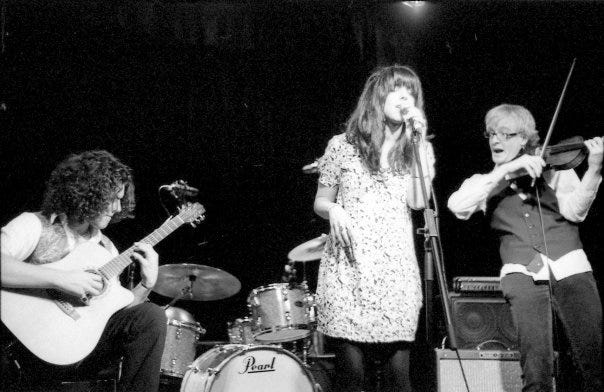
I found solace in the arts- it felt complex and full of life, and the spirit I so desperately was looking for. I painted a picture of myself (to myself), as a candidate for the female Nick Cave. But with that, I thought, I shouldn’t weaken my dream, with surface chat about my Jewishness.
It’s important to note, this wasn’t some single dramatic act of concealment. It happened gradually, almost embarrassingly professionally, in response to the rooms I was in and the patterns I started noticing inside them.
The industry wasn’t ever neutral. It had its own moral weather…it still does. Its own language and conversations about power and identity. People signaled themselves constantly, sometimes directly, more often through tone, through implication, through what they approved of…and what they didn’t. Within that structure, certain views were simply understood to be correct.
I understood pretty early that to introduce myself into that environment as both Israeli and Jewish would not be a neutral act.
No one said this to me or warned me. You could just feel it in how conversations moved, in what everyone assumed was shared, in the speed with which certain positions were taken and the faint but unmistakable closing of the air when anyone drifted outside them.
So I adjusted and became a compulsive omitter. My Jewishness remained central in my internal life, but I didn’t foreground it professionally. I let other things stand in front. And that arrangement worked…it cost me minority dollars; but I would cash them in when the daily question “where are you from” would inevitably come- to which I would answer “I’m half Middle Eastern’.
So, I collaborated, built relationships, moved through the industry without drawing the kind of attention that would complicate all of that. People knew me through songs and projects and conversations about art. Not through the contested territory of identity or if my uncle secretly rand the music industry (he didn’t- he’s a chess champion).
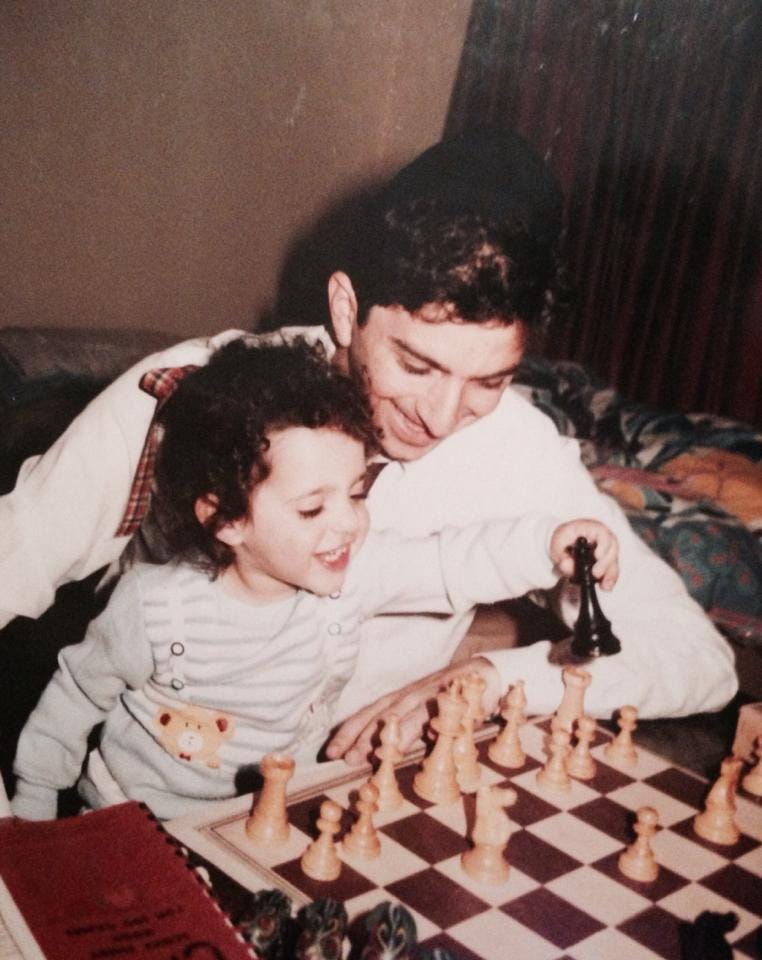
Okay, but I want to tell young Anita something right here: Silence doesn’t erase identity- it simply relocates it. It creates a division between the self that is moving publicly through the world and the self that remains waiting in the wings, unnamed but entirely present. And young me already knew, there were moments when the split became visible.
I’d hear people talking about my people. I’d hear the conversations about Jewish money - financial requests from friends, who if they knew me at all, knew I came from no such privilege- Jewish jokes (often funny, sometimes not) - I shelved the comment about me being a ‘Spoilt fucking Jewish Princess”, my cocaine addicted housemate flung at me. The comments made by lovers about Jewish female stereotypes in bed. Usually, I said nothing to be practical. Bringing complexity into a room that isn’t built for it takes energy and requires context, and often means becoming a problem before you’re allowed to be a person again. Silence preserved position. And so the pattern continued for about fifteen years.
In that time I built a tiny career. I had representation and worked with collaborators I respected. On the surface, the structure held.
What I knew, though mostly without saying it even to myself, was that part of that stability depended on what remained omitted. The identity I hadn’t named had not vanished. It was simply waiting in the wings.
But then 2021, that arrangement was tested.
There was another escalation between Israel and Gaza. As always, information moved fast and spread before anyone had time to think. Language appeared almost instantly alongside them, often in identical or near-identical phrasing, as though people were not so much responding to events as activating material already prepared for use “Genocide, Apartheid, From the River to the Sea”.
What struck me was not only the speed but the coherence. The frame was already there and it was like someone pushed a button that alerted the progressive masses, to ‘GO’. I was disturbed.
I decided to speak publicly.


What I said was not expansive nor was it a manifesto or policy argument - It also wasn’t some comprehensive attempt to explain the conflict. It was, at heart, an act of identification. I said that I was Israeli. I said that I was Jewish. I placed myself in relation to what was being discussed.
The response was immediate.
I lost about 1000 social media followers, and within a short time of my speaking, I was dropped by both my booking agent and my management. The explanations were vague in the way professional explanations often are. “The industry is hard.” “There are too many artists.” “It is difficult to sustain everyone.” Blah blah blah. None of these things were inherently absurd and all of them were plausible enough to function.
What was missing was any direct mention of what I had said. But the timing said enough. Whether or not anyone was prepared to name the relationship, the relationship was there.
Over the weeks and months that followed, I noticed other shifts. Opportunities that would once have been within reach didn’t materialise. Conversations in the industry developed a different tone. People asked questions they had not asked before, or asked them in a way that let me know I had moved, somehow, into a different category in their minds. It definitely wasn’t a total shutout. That would almost have been easier to read. It was a narrowing.
I tried to explain it away. The industry changes and work comes and goes. Maybe I was drawing too straight a line between disclosure and consequence. I gaslit myself a lot.
But the pattern held. The decline in opportunity sat too neatly beside the moment I’d publicly identified myself. The scrutiny that followed was too specifically shaped. I had the growing sense that once my identity was named, it began travelling ahead of me into rooms I was not in.
None of this was formally stated and it didn’t need to be. Sometimes the most legible thing is an absence. My identity became a point of reference in conversations that were no longer strictly about my work. This was not universal. Not every person became hostile, and not every opportunity disappeared, but the baseline had changed.
The arrangement under which I had been operating, the one partly built on omission, no longer held in the same way. The method had failed.
So I adapted again.
I withdrew from public engagement on the issue. I stopped posting and I let the subject recede.
I shifted career focus. I stepped away from the music industry, in a meaningful way.
The hope was that things might settle. For a while, they seemed to. Silence became, again, a kind of re-entry.
I knew now what the cost of disclosure could be. That knowledge stayed with me. It shaped every later decision about what to say, when to say it, and whether saying it was worth the consequences that might follow. Participation was still possible, but it was certainly not neutral.
October 7, 2023.
I was away on a screen free date with my new husband. When we arrived back to our phones that evening, I could tell in his eyes, our world was about to change.
In the first hours, then the first days, the material coming through did not yet sit inside a stable narrative. Images were everywhere, but they had not yet been fully processed into the familiar forms of interpretation people use to place themselves quickly inside a moral position. For a brief period after an event of that scale, reality moves faster than explanation. I knew I was still inside that gap. The footage arrived before the sentences. Clips appeared stripped of context, or carrying partial context that shifted by the hour as more became known. What seemed verifiable one moment became more complicated the next. The sequence itself had not settled. You could see what had happened without yet being able to say, in any finished way, what it meant.
But I was broken and delayed, like every grey faced Jew I knew. We had no duty, but to register what was unfolding and to remain upright. But like many, I was not watching as a distant observer.
Members of my immediate family, including my mother and my brother, were in Israel. That changed the scale of everything. My attention was divided between the raw public stream of horror and the private arithmetic of waiting. Messages arrived in fragments, sometimes with half finished updates. There were stretches of silence that no amount of scrolling could fill.
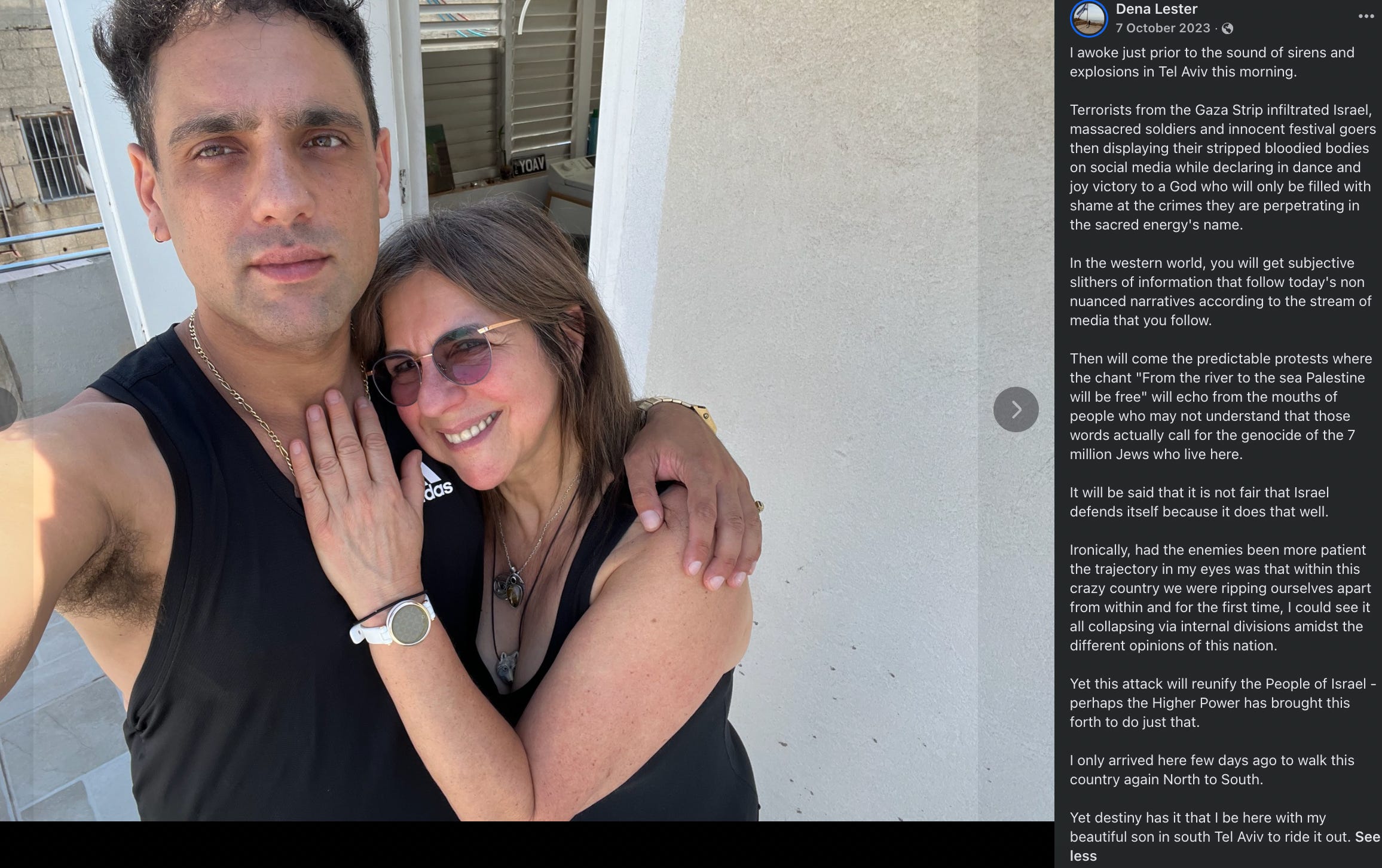
Distance, then, did not feel abstract, but measurable. How long since the last message? How long to confirm someone was safe? How long before a fragment of information became something solid enough to lean on? Seeing my brother ping online 2 minutes ago- okay we can all breathe…or can we? Inside that reality, the public conversation felt secondary.
I had already learned in 2021 what public engagement on this subject could cost. There was no reason to think those conditions had improved. What I did notice was that language was forming rapidly all around me.
In my immediate social and professional circles, statements began appearing almost at once. They presented conclusions. Not observations. Conclusions. And the speed of that told its own story. These interpretations had not been built from the event alone. The event had activated a structure that was already waiting. The button was pressed ‘GO’.
What I saw much less of, in those same networks, was any acknowledgment of October 7 on its own terms. Very few people seemed willing to remain with the fact of what had happened before absorbing it into a pre-existing framework. Fewer still reached out to me directly, despite knowing who I was and where my family was.
There were no messages asking if my family was safe from many of the people who knew they might be in danger. No pause or opening. No room made for the possibility that someone in their midst was not experiencing this as an abstract political development but as something immediate, intimate, and terrifying- or was this a ridiculous assumption to make?
The absence was not total. A handful of people outside the creative world did reach out. Their messages were simple and human. They were about my family, not about discourse. That difference stayed with me.
Inside the creative community where I had spent most of my professional life, the event moved almost instantly into ideological language. There was very little patience for the interval I was still living in, the interval in which the facts had not yet finished arriving and the dead had not yet even been fully counted.
So in the days after October 7, I stayed mostly silent.
Until it didn’t.
By October 9, it had closed enough that silence no longer felt like a refuge. It felt like participation in something I could no longer ignore.
For me, it began on October 9.
Two days earlier, October 7 had still existed in that raw state before language mythologises around an event and tells everyone how to feel. Reality had not yet fully been processed into a moral choreography. I still believed, perhaps naively, that there might be a little more time before people rushed to certainty.
By October 9, that time was gone.
Around then, a close friend of mine, a successful musician whom I’ll call C, attended the march in Sydney that ended at the Opera House. Later, it became strangely difficult to determine where exactly she had been in relation to the steps themselves. That distinction took on a symbolic charge in the weeks that followed, though at the time it was less the geography that stayed with me than something she had said beforehand.
She had told me directly that as a visibly queer person she felt unsafe in spaces marked by a strong conservative Muslim presence. She was not speaking theoretically. She was talking about risk as she understood it in her own body and life.
I took that seriously because it was serious. And, if I’m honest, I also felt a certain relief hearing it. After what I had already gone through in 2021, after starting to feel the walls closing in around what could and could not be spoken in creative circles, I let myself believe there might still be room for contradiction. That perhaps reality could remain untidy.
I saw so much in those early days. After questionable commentary, I privately reached out to two artists I considered friends. I’ll call them K. and M. Both are high-profile musicians. Both are queer. Both are people of colour. Both move with fluency and authority through the language of identity politics, intersectionality, embodiment, oppression, all of it. They knew that language well and occupied positions within it that carried both social and moral legitimacy.
I thought there might be room to speak honestly with them based on the certainty around their public and influential commentary. My intention wasn’t to attack them. I wasn’t even trying to dismantle their politics or defeat them in an argument. I wanted to understand how they were seeing events, and if there was space, to offer my own experience, including what I had lived through in Israel and the caution I carried because of it.
With K, the conversation began in what looked like good faith. She approached me with a tone that suggested openness. It felt, for a brief moment, like a private exchange between two people who knew each other. With M, I assumed the same thing. That what was being said would remain between us, or at least within the ordinary moral boundaries of private conversation.
That assumption didn’t last.
Very quickly, within days of October 7, I was being called racist, bigoted, genocidal…etcetera! Almost instantly, as though these conclusions had existed before the conversation and my role was simply to step into them. There was no real middle stage or pausefor curiosity or attempt at clarification.
In my exchange with M, I said something I meant as a limit. I said that being a person of colour or Indigenous does not give someone the authority to define the indigeneity of others. I did not say it to provoke. I said it because I believed the terms of the conversation were being falsely fixed in advance.
What happened next told me the conversation was never going to remain private.
Not long afterwards, I began receiving responses from people who had not been part of the original exchange at all. They were referring to things that could only have come from it. My words had moved beyond me. They were being circulated, reframed, interpreted elsewhere, and I no longer had any control over how they were being carried.


That changed the scale of everything. I was no longer having a disagreement. I had become a subject for people.
I was framed ideologically as a racist, a bigot, an apologist for violence on one end. At the other end were people who did not engage directly but helped create the conditions in which those accusations could circulate without resistance. They let the framing stand. They moved with it. They amplified the atmosphere if not always the words.
The distinction between active and passive participation started to matter less. So much so that blocking became the new black.
At its worst, this period culminated in a death threat so explicit that a woman was eventually imprisoned for it. She left voicemails saying she would do years in prison just to kill “a Jew dog.” There was no ambiguity in that language. It did not need interpretation. It belonged to the old world and the current one at the same time.
By then, the category had changed entirely.
And this was all happening inside a broader cultural atmosphere that was already aligned. Public figures whose work travelled widely through the same circles I inhabited were engaging in rhetoric about Israel that blurred the line between critique and total moral annihilation. Their language was not fringe language. It was shared, reposted, celebrated, normalised. People who would, in other contexts, have recognised certain kinds of speech as dangerous seemed suddenly willing to tolerate or even embrace it so long as the target remained the same.
That was part of the shock. The normalisation.
I found myself increasingly unable to reconcile how many people in progressive creative spaces continued collaborating with figures whose rhetoric, in any other setting, would have been called what it was.
And at the same time another fracture appeared, one especially painful for many Jews. This was the emergence, or perhaps the public consolidation, of a strongly antizionist (one word) position within parts of the Jewish community itself.
I had encountered this before October 7. During a Jewish arts festival I was involved in, an activist I’ll call E.T.R had been scheduled on a panel. Concerns were raised about statements she had made publicly. She was removed from that panel but offered another panel and payment. I know this because I knew the organisers. She declined, boycotted the festival, and publicly accused it of bigotry.
The sequence mattered because it set a template.
After October 7, E.T.R, along with N.Z and Z.M, became involved in social media fundraising campaigns for Gaza, framed as humanitarian. I want to be clear here. I do not object to humanitarian aid - my concern is that in conditions like these, the routes money takes are not always transparent, especially when broader protest ecosystems can intersect with state influence and indirect funding streams in ways ordinary supporters do not fully understand.
But the more immediate issue was not only fundraising. It was boycott. It was the development of rhetorical systems that made the boycott of Jewish organisations feel principled, even virtuous.
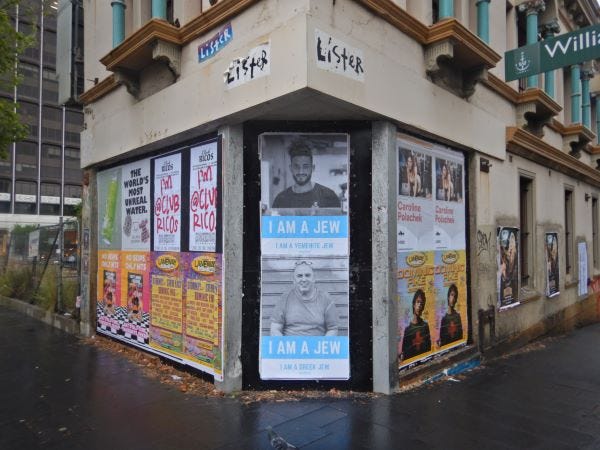
Around this time, in response to the increasingly common claim that Jews are simply white, I worked with a small group and a publication to develop a local poster campaign. My brother, who lives in Israel, photographed a range of Jewish people whose appearances reflected the actual diversity of Israeli society. The campaign was called I Am a Jew. Each poster simply said: “I am a Jew.” It was modest and local and just used the old school postering mechanism as it’s platform. No institutional machine behind it
.
The reaction was immediate. People didn’t begin by engaging with the content. They began by hunting for authorship. Who is behind it. Who is running it. The posters themselves became less interesting than the possibility of exposing whoever had dared to produce them.
Because of a technical error in the downloadable files, my name became attached and with that the anonymity disappeared.
After that, the messages began. Aggressive and targeted, and often from Muslim men and antizionist women and non-binary folk. That is not a political abstraction but simply the pattern I observed. Some of the messages were incredibly abusive. Some were attempts at doxxing. This was before the wider public had fully caught up with how normalised those tactics were becoming.
At that point, I had become a focal point for several overlapping worlds at once. The audiences around certain public figures. Segments of the queer progressive music scene. Antizionist Jewish circles. People who, for different reasons, were ready to attach me to a larger story and use me accordingly.
One example among many: Z.M was contacted by an employee of my mother’s - J.R, who relayed a series of claims about both of our conduct within her workplace that were, in substance, untrue and fundamentally racist. Z.M shared the messages publicly, as an attempt of accusation. I asked her to remove the posts, but she dug her heals in even more, encouraging her followers to increase abuse. Over the following months, my mother’s school continued to receive threats linked to the same line of allegations.


Countless social losses followed. Countless. The concept of this loss began to haunt me with a familiarity I had once dismissed in my grandparents’ stories, their almost paranoid refrain that they had been betrayed by those closest to them. I had never fully believed it, or imagined it could repeat. I was married in February 2023, and a year later, looking back through the photographs, I realised that many of the people captured there were no longer in my life- some had had turned, and a number had pushed far enough against my position that the only coherent response was to let them go.
This was the new world.
Sometimes people told me directly that they did not want to work with me. Other times the information came through intermediaries. Someone had been advised against associating with me and another thought it would be bad for optics. Someone even considered me a risk. The language changed depending on how honest the speaker wanted to be. The outcome remained remarkably consistent.
Informal (mainly) exclusion.
It spread into the architecture around professional life. Shared studios and networks plus the social gatherings orbiting the industries I swam in. Places where careers are made possible through belonging. I became keenly aware of certain spaces becoming less available to me.
I went to events where the whispering didn’t follow the rules of what a whisper is supposed to be, and I walked into to conversations that pushed me to walk out of the venue. When I did stay- remained, the terms of presence had changed. I became aware, more than once, of people talking near me or about me in ways that made clear that my identity had become a topic in rooms where I was no longer presumed to belong unmarked.
That experience is difficult to quantify because it does not always produce one clean incident. It accumulates. Small cuts, you know.
Over time, it changes the map in your head. You begin to anticipate friction. You think ahead and trim your own movements- I no longer feel safe going to many creative events…so I don’t go at all.
There were times when I chose not to wear a visible Jewish symbol. A Star of David that I would once have put on without thought became something I assessed according to suburb, setting, event, even whether I was getting into a stranger’s car.
The ordinariness of it all is part of what makes it worth documenting. Each decision on its own was little, but when joined together, they marked a change in the terms of daily life.
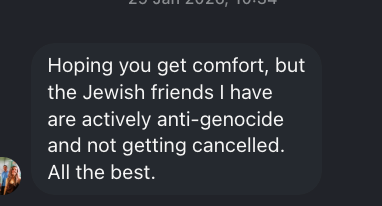
And recently, someone finally said out loud what had been operating underneath so much of this all along. A member of a band, in which I have friends, told me plainly that if I were the kind of Jew who could turn my back on Israel, I would probably be less excluded. He said it in this ‘kind hearted’ practical observation, kind of way, enough so that I had to be explicit so he may understand the racism of it all. Participation, in other words, was available on terms
.
At a certain point, it stopped making sense to understand what had happened to me as exceptional.
A person would tell a story they thought was idiosyncratic and another person would say, yes, in another form, that happened to me too. That matters, because one of the secondary injuries in all of this is the lack of documentation. These patterns are not well recorded in the public language of the creative sector. They rarely appear in formal institutional reviews. They do not get much coverage as patterns in their own right, so they remain stranded at the level of anecdote, where they can be waved away as subjective, exaggerated, emotional, misread.
There is always a temptation, when describing exclusion, threat, or the slow tightening of conditions around participation, to reach immediately for the largest historical frame available. Those frames exist and are near at hand. They carry weight and offer language already charged with memory. I have tried not to lean on them here.
The associations live close to the surface for many Jews, whether spoken or not. But I do not think analogy is required in order to establish what is happening. What I have described stands on its own terms. It doesn’t need historical amplification to become legible.
And yet history is not absent either.
When you find yourself wondering whether to wear a visible marker of identity, or checking the atmosphere of a room before entering it, or deciding whether a conversation can bear the truth of who you are, you become aware that these are not wholly new gestures. They have precedents. That awareness doesn’t mean that the present is the past- the scale does matter though.
Mechanisms matter, as does context and outcomes. To ignore those distinctions would be irresponsible. It would flatten history and flatten the present at the same time. But to pretend there are no recognisable patterns at all would also be false.
So the task is restraint. To say only what can be observed. To remain with what is directly knowable. To describe the condition without theatrical inflation and without pretending that historical memory does not shape how such conditions are felt.
_____
I didn’t set out to become an advocate.
I am an artist. That was meant to be the centre of things. For a long time, I believed that work might be allowed to remain work, and that identity, while always present, would not necessarily determine the terms on which the work could be made, shared, or received.
That belief has been altered.
What I’ve described here has changed the conditions of participation. Not absolutely. I can still participate. I can still make work. I can still move through the world. But not neutrally.
There is now, too often, an added layer of assessment, adjustment, and at times concealment. Those are not abstract burdens. They are practical ones. They shape decisions about what to say, what to leave out, where to go, what to wear, which rooms to trust, and which versions of oneself can safely appear in them.
These conditions are not evenly distributed across the field. They are experienced in specific ways by specific people in specific environments. But that does not make them minor. It makes them traceable.
The cumulative effect is what matters. It changes the terms of belonging…and where that may lead.
And I want to be clear about something. I’m not writing this to claim special status or to claim emotional injury. I’m writing it because a sequence occurred, and because that sequence, once repeated often enough, becomes a condition worth recording.
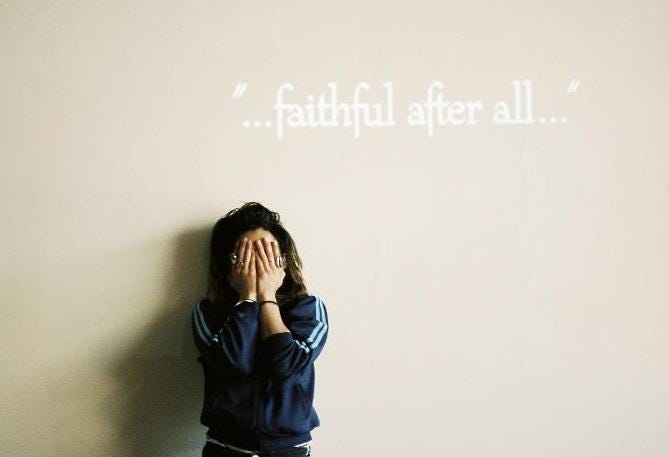
This account is simply a record of the new wave
.
Anita I am blown away by the eloquence and devastation of this account. Thank you for writing this, for pinning this to the page. You have written history here. I am so sorry you had to live it and are living it. It is an exceptional essay and should be published in Tikkun or Hey Alma. It’s inspired me to write something for the Commission as I’ve been vacillating. But these accounts are not for them, not really. They’re for us. 🙏🙏🙏
Thank you for this incredible essay. I do hope the RC read it in its entirety.